
This week was the 25th anniversary of the Disability Discrimination Act becoming law. Passed on 8 November 1995, the act made it unlawful to discriminate against disabled people in relation to employment, the provision of goods and services, education and transport. The act was amended in 2005 to shift the focus from bodies being required to make ‘reasonable adjustments’, to proactively promote equality of opportunity for disabled people. Prior to joining wheelchair rugby I had minimal knowledge or contact with disabled people. When I took the job I was very anxious about ensuring that I interacted appropriately, and that I didn’t through my own ignorance cause offence or embarrassment to those who were now part of my daily life and who I wanted to do a good job for. I realised I needed to work at trying to learn and to understand some of the experiences of disabled people, and I was fortunate to have Richard Allcroft, now our IWRF President, to take me under his wing and mentor me. Through his patience, wit and good humour, he made it comfortable for me to ask the questions I might otherwise have been embarrassed to ask, and he gave me the confidence to make mistakes. I have many others to thank for helping me on this journey of learning, not least Mike Spence, Archie Palmer, Justin Frishberg, Andy Barrow, Bob O’Shea, Paul Shaw… the list grows daily as I meet and interact with individuals who enrich my life and influence my thoughts and behaviours.
I’m still learning, but perhaps my most important recognition has a relevance which goes beyond my relationship with those who are disabled. I am now much more sensitive to recognising that all people are individuals and need to be understood and treated as such. Society’s practice of categorising people into neat groups – black males, white males, working class, single parent, transgender, disabled – is both dehumanising and dangerous, because all labels come with perceived traits and ignore the uniqueness of the individual person. And here I am not referring to the different physical and mental impairments which create difference, I am focusing on the uniqueness of the human spirit. We are all individuals with our strengths, our weaknesses, our insecurities, our loves and our fears, this is as true for those of us who are able bodied as it is for those who are disabled.
I have also come to understand and to respect the resilience and patience that disabled people mostly display. Many times I have witnessed their daily struggles to do ordinary things. The many times I have walked alongside colleagues in their chair and found it impossible to enter a building because of the physical constraints, or to witness how inaccessible our transport systems still are meaning that it takes a great deal of planning and much more time to get somewhere. As an able bodied person I feel ashamed that in the 21st century disabled people are still facing exclusion caused by the inaccessibility of much of our infrastructure and the way in which our society is organised.
But the real shame is not so much the lack of accessible facilities, it is the systematic and structural inequalities that disabled people still face and the prejudice and ignorance that is often shown towards them. The abolishment of the Disability Living Allowance and its replacement with the Personal Independence Payment has created real pain for many disabled people. Figures from the Department for Work and Pensions show that 46% of all of those who have moved from the old system are financially worse off. I still bristle with anger when I witness some of the behaviours and attitudes which impact on the disabled. The number of times I have stood on a pavement alongside someone in a chair whilst a taxi with its ‘For Hire’ light illuminated just whizzes by to then stop fifty metres down the road to pick up an able bodied person, or been in a bar where people are standing drinking whilst shouting to their colleague who is separated from them by a person in a chair below who seems invisible to them. We still have a long way to go to create a more inclusive society where dignity and respect is shown to everyone.
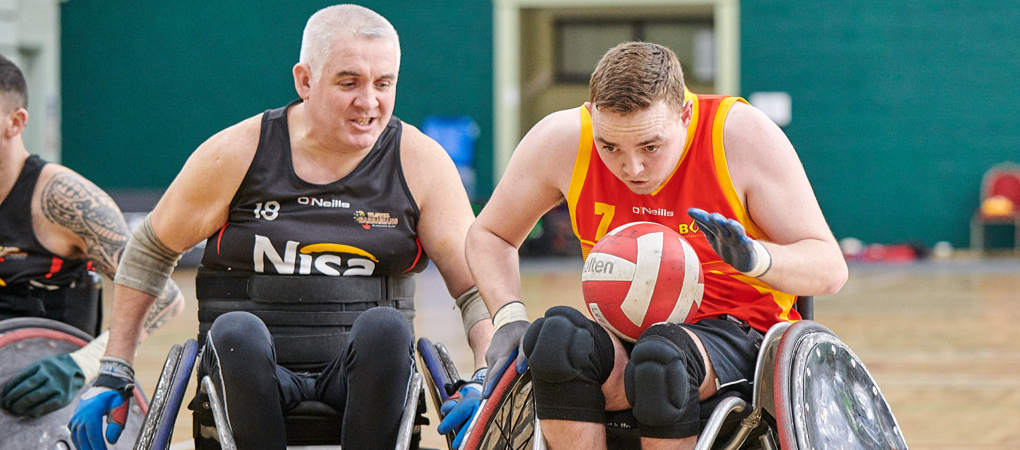
As a sport we have a fantastic opportunity to help educate and change perceptions about disability. Ours is a demanding, physical sport played by men, women, boys and girls, all of whom defy the stereotypes of what it is to be a disabled person. Our athletes have no choice but to face up to the obstacles of daily living; they do this by adapting, learning new skills, demonstrating remarkable resilience, courage, patience and commitment. All too often we, the able bodied, focus on the vulnerabilities of those who have a disability, rather than on the strengths of the individual and what they can teach us. The truth is we all have our limitations and we are all disabled in our different ways. Our sport gives us a unique platform to demonstrate how we can change perceptions about disability, build bridges between communities and help create a more integrated society.
David Pond, Chief Executive


